In the world of student affairs, effective leadership isn’t just about knowing policies, managing processes, or launching successful programs. It’s about people. It’s about emotions. It’s about being the kind of leader who creates trust, shows up with integrity, and builds teams that thrive—even under pressure.
In short? It’s about emotional intelligence (EQ).
Across fields—from student development to business strategy—research confirms that emotional intelligence is a cornerstone of strong leadership. It enables better decision-making, stronger teams, and healthier workplace culture.
Let’s explore why EQ is not just a “nice to have” for student affairs leaders—but a professional imperative—and how you can apply it with purpose and impact.
What Is Emotional Intelligence?
Emotional intelligence refers to your ability to recognize, understand, manage, and use emotions—both your own and others’—to guide thinking and behavior.
Daniel Goleman, who popularized the concept, outlines five core EQ skills:
- Self-awareness
- Self-regulation
- Motivation
- Empathy
- Social skills
These traits shape how we lead meetings, respond to conflict, coach staff, and support students through emotionally complex moments.
At Harvard Business School, leadership experts emphasize that leaders with strong EQ are more effective in managing stress, resolving conflict, and fostering trust—all of which directly correlate with team performance and morale.
Why EQ Matters for Managing Student Affairs Teams
1. EQ Drives Professional Competency
Williamson’s research makes it clear: emotional intelligence supports professional effectiveness. Those with higher EQ tend to lead more confidently, communicate more effectively, and navigate ambiguity with greater ease.
This means when we invest in emotional intelligence—for ourselves and our teams—we’re also investing in performance, innovation, and long-term impact.
2. EQ Builds Stronger, Safer Teams
Student affairs is collaborative, and collaboration requires trust. Leaders with EQ foster psychological safety, a trait that Harvard Business School identifies as essential for high-performing teams.
Patti and Stern call this the “ripple effect”—when leaders manage their own emotions well, the team becomes more emotionally regulated, grounded, and open.
3. EQ Enables Culturally Responsive Supervision
Snowden’s findings remind us that emotional intelligence is shaped by identity and lived experience. Emotionally intelligent leaders understand that their team members may express emotion differently, lead differently, or process conflict in ways tied to their racial, gendered, or cultural backgrounds.
Inclusive EQ means making space for multiple leadership expressions—not just dominant cultural norms.
4. EQ Improves Retention, Resilience, and Well-Being
Student affairs is deeply human work, which means it can also be emotionally exhausting. Leaders with emotional intelligence see the signs of burnout, know how to respond to emotional overload, and create cultures of care—not just productivity.
According to the Harvard Business School blog, leaders with EQ inspire loyalty and drive, while leaders without it risk team disengagement, breakdowns in communication, and high turnover.
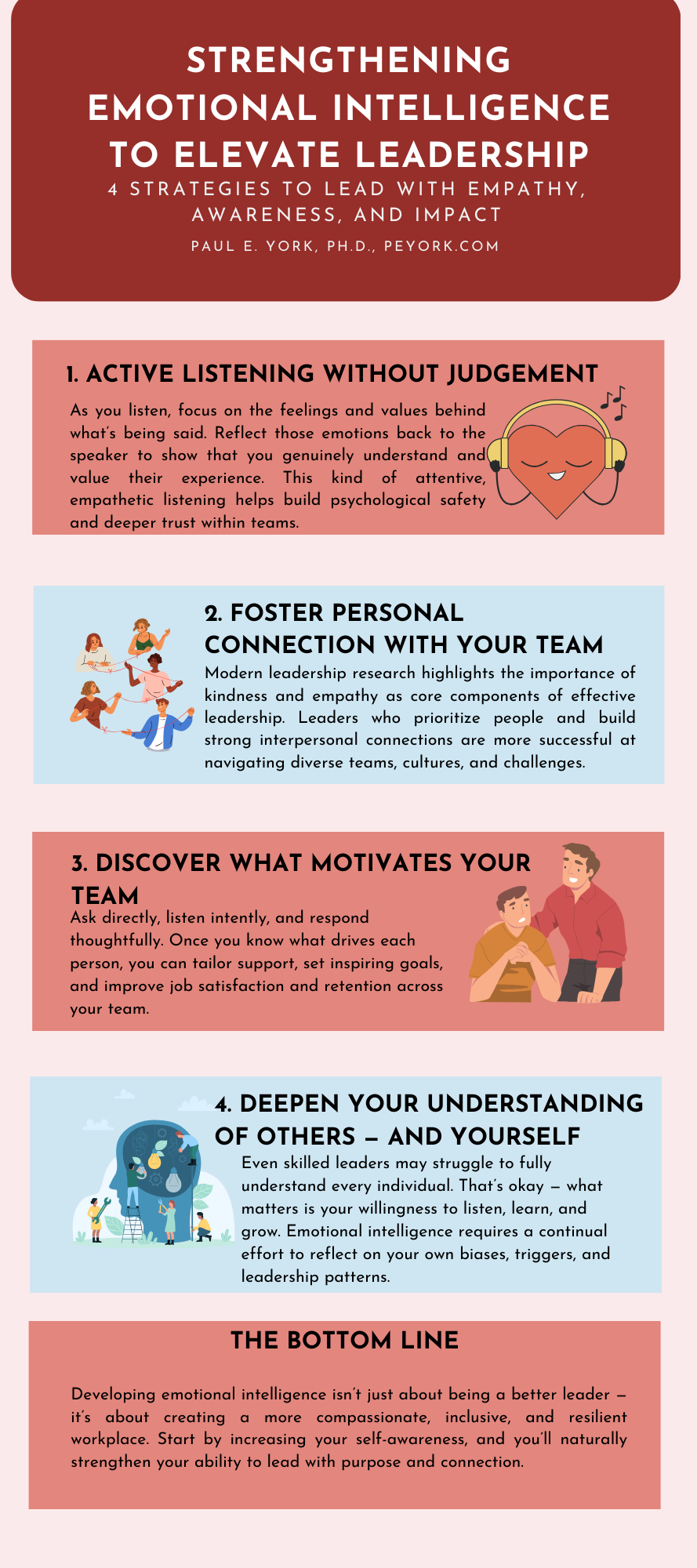
How to Lead with Emotional Intelligence
1. Cultivate Self-Awareness
EQ starts with knowing yourself—your triggers, patterns, stress responses, and values. Without this awareness, it’s easy to lead reactively instead of reflectively.
Try this:
- Journal about emotionally intense leadership moments: What did you feel? How did you respond? What might you do differently?
- Ask trusted colleagues, “How do I tend to show up emotionally in tough conversations?”
2. Regulate Your Emotional Responses
Leadership is full of emotionally charged situations. Your ability to pause, breathe, and respond rather than react makes a measurable difference in team dynamics.
Try this:
- Use the “3-breath rule” before responding to emotional feedback or conflict
- Delay major decisions if you’re emotionally flooded
3. Lead with Empathy and Curiosity
Empathy is the heart of EQ. But it’s more than being kind—it’s being curious, nonjudgmental, and able to understand what people need without imposing your own lens.
Try this:
- Ask, “What support would feel most helpful to you right now?”
- Replace assumptions with, “Help me understand what’s underneath this.”
4. Make EQ a Shared Value
Emotionally intelligent teams don’t just happen—they’re built. Develop EQ together by:
- Creating space in meetings for emotional check-ins
- Naming emotional dynamics during group processes
- Providing training, coaching, or resources on communication and self-regulation
Try this:
- Host a professional development session on emotionally intelligent supervision
- Invite staff to reflect on how identity shapes their leadership and emotional needs.
Emotional Intelligence Is Strategic, Not Soft
From Harvard Business School to NASPA to your campus leadership team, the message is clear: emotional intelligence is no longer a “nice to have”—it’s a strategic competency.
In student affairs, where every policy has a personal impact and every decision touches a community, leading with EQ means leading with intention, inclusion, and care. It’s how we build trust. It’s how we support our teams. It’s how we stay grounded through the hard stuff and grow through the good.
It’s not just heart work. It’s smart work.
Want to bring this to your team?
- Let’s build a custom EQ workshop or retreat for your division
- Explore the NASPA/ACPA competencies through the lens of emotional intelligence
 Paul York, Ph.D.